
Key Differences Between Forklift and Reach Trucks
Choosing the wrong lift truck can quietly drain your budget through wasted space, slower cycles, and unnecessary wear. Forklifts and reach trucks look similar at a glance, but they are built for different jobs, and understanding that difference is what keeps your operation efficient. Both machines lift and move palletized loads, yet each one shines in conditions where the other struggles. Put a standard forklift in a tight, high-density warehouse and you lose storage capacity. Send a reach-truck outdoors onto rough ground and you limit its strengths. This guide breaks down what each machine is built for, where it performs best, and how to match the right one to your work.
Forklift
Design and Build
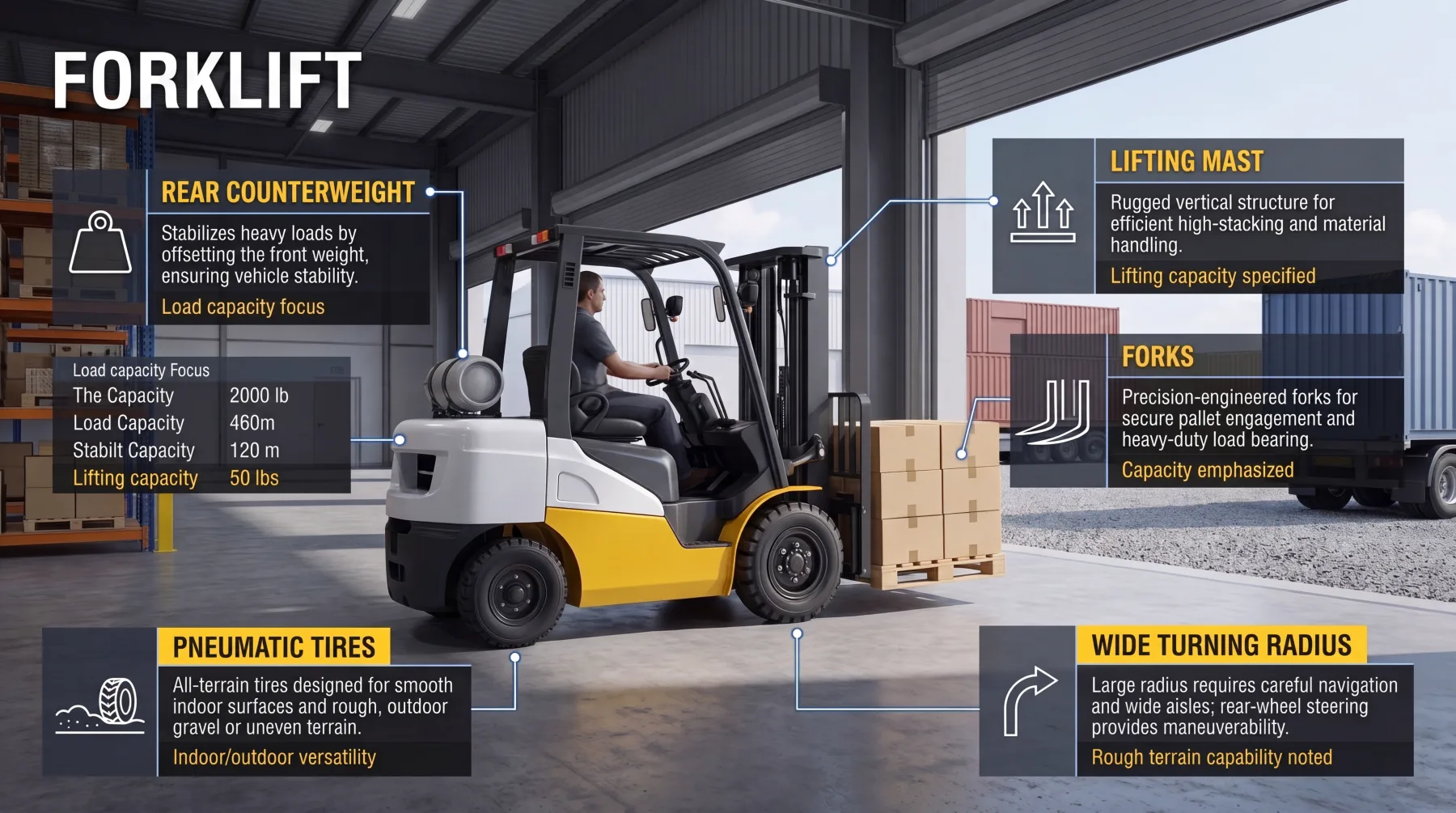
A standard forklift, often called a counterbalance forklift, is designed for general material handling across a wide range of settings. Its weight sits at the rear of the machine to counterbalance the load on the forks, which lets it lift and carry heavy pallets without tipping forward. That rugged, self-balancing structure is exactly why you see forklifts working in warehouses, on construction sites, in shipping yards, and across outdoor lots. They are the all-purpose workhorse of material handling, built to handle varied loads in varied conditions without being limited to a single environment or surface type.
The forklift’s sturdy, counterbalanced frame makes it dependable for heavy, general-purpose work in nearly any setting. It does not rely on outriggers or a specialized aisle configuration to stay stable. The machine itself carries the balance, which gives it the freedom to work wherever the job demands, indoors or out, on smooth floors or rough terrain alike.
Load Handling and Lifting Capacity
Forklifts are the stronger choice for heavier and more varied loads. They comfortably manage everything from standard pallets to bulky construction materials, drums, crates, and irregular industrial goods. Their counterbalanced design and robust build give them the muscle and stability to lift substantial weight and carry it across a site, which is why forklifts are the go-to machine for demanding, mixed-load work in warehouses, manufacturing plants, and outdoor job sites alike.
Lifting is capable at lower and moderate heights, and forklifts excel at moving heavy loads quickly from one point to another. Where the design begins to show its limits is at significant elevation in dense racking, where the geometry of a wide, counterbalanced machine makes precision placement more difficult. For ground-level and mid-height operations involving heavy or unpredictable loads, the forklift’s capacity and durability are hard to beat.
Maneuverability Across Surfaces
Forklifts are the more adaptable option when it comes to surfaces and environments. Their sturdy build, larger tires, and available options like pneumatic or cushion tires let them work confidently on rough outdoor ground, uneven yards, gravel, and loading docks. A forklift can move from inside a warehouse to an outdoor storage lot without missing a beat, which makes it a reliable performer wherever the terrain is unpredictable or the work spills outside four walls.
The trade-off for that surface versatility is aisle width. A forklift needs wider aisles to turn and position loads properly, so it uses more floor space in a dense racking environment than a reach truck would. On open sites or mixed-use facilities where that space is available, the forklift’s all-terrain confidence is a genuine asset that keeps the machine productive across a wider range of conditions than any specialized indoor machine can match.
Reach Truck
Design and Build
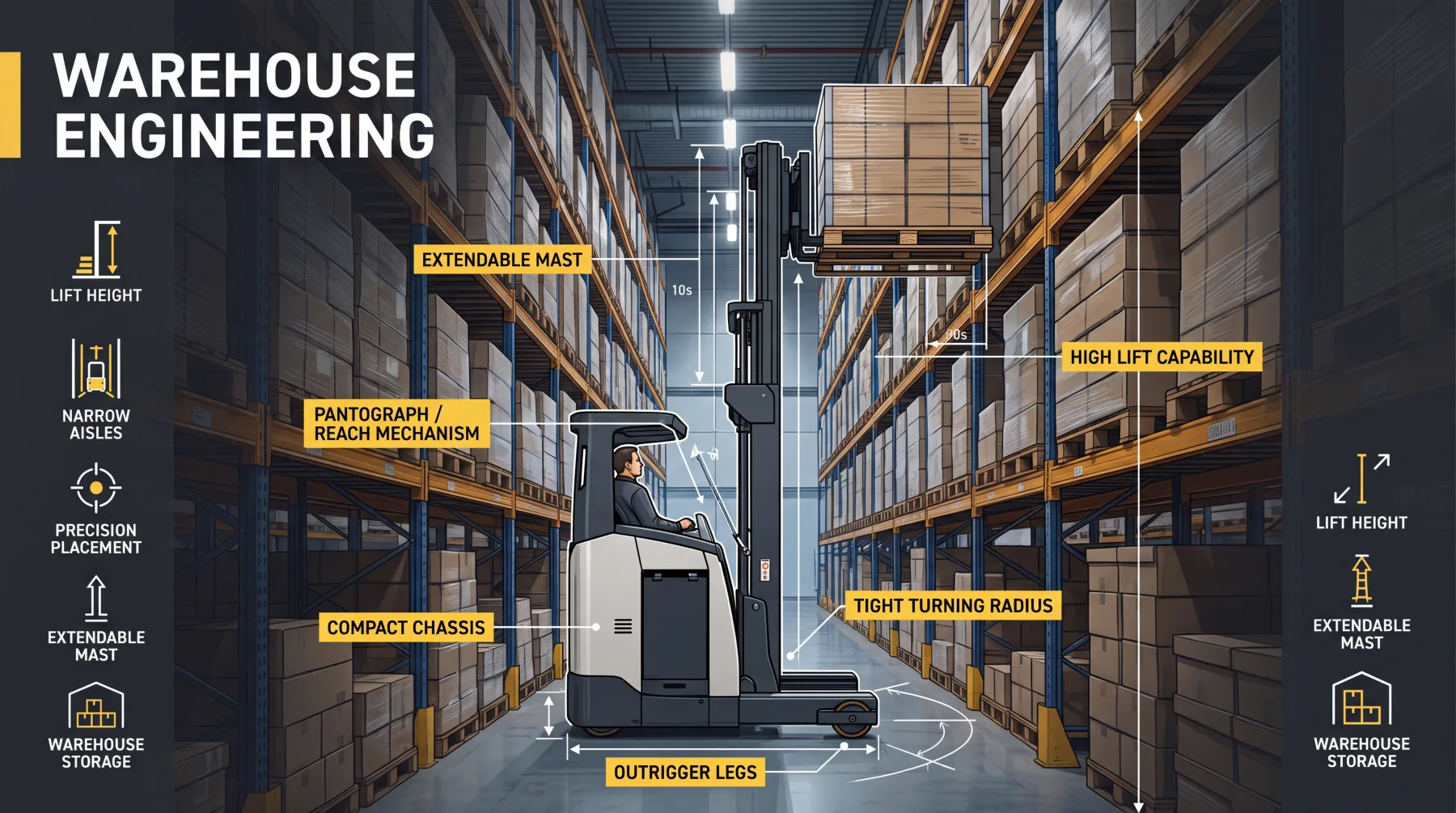
Reach trucks take a fundamentally different approach to design. Instead of relying purely on counterbalance weight, they use an extendable mast system, sometimes paired with a pantograph or scissor mechanism, that lets the forks move forward and backward independently of the machine body. Rather than driving the whole machine up to a rack, the operator positions the truck in the aisle and extends the forks to place a load deep into the rack. Stabilizing outrigger legs at the base replace the heavy rear counterweight, keeping the machine compact while still supporting elevated loads.
That slim, outrigger-stabilized body is exactly what allows a reach truck to work in the narrow aisles where a forklift cannot go. The machine is purpose-built for the controlled, precise demands of indoor warehouse racking, and its design reflects that focus entirely. Every dimension, from the compact width to the extending mast, is engineered to maximize performance in that specific environment.
Lifting Height and Storage Capabilities
When vertical storage matters, the reach truck pulls clearly ahead. These machines are engineered for high-density warehouse operations where floor space is limited and the smart move is to store product higher rather than wider. A reach truck can lift loads to heights that a standard counterbalance forklift simply cannot match, often reaching the upper beams of tall racking systems that climb well past 30 feet. That vertical capability lets warehouses turn empty overhead space into usable, productive storage without expanding the building’s footprint.
Because the mast reaches forward to set a pallet into the rack, the operator does not need to drive the machine deep between the beams. This combination of extension and elevation is tailor-made for narrow-aisle racking systems, where every inch of floor is dedicated to storage rather than driving space. The result is a facility that holds far more inventory in the same footprint, which is the core reason reach-trucks exist.
Load Handling and Precision
Reach trucks approach load handling with a focus on precision rather than raw capacity. They are optimized for lighter loads and tasks where accuracy matters more than brute strength. In a high-density warehouse, the priority is placing pallets exactly into designated rack positions, often at significant height, without disturbing neighboring loads. The reach truck’s extending mast and refined controls let operators set product cleanly and precisely into tight storage slots, making it the ideal tool for organized, efficient inventory management.
Inside a warehouse, the reach truck’s compact frame and tight turning radius give it maneuverability that a standard forklift cannot approach. It threads through spaces only slightly wider than the machine itself, which lets warehouse managers shrink aisle widths and dedicate that reclaimed space to additional racking. In those close quarters, the reach truck moves with a nimbleness that keeps product flowing efficiently even in the tightest layouts, provided the floor is smooth and level.
Which One Suits Your Work Profession
The right choice comes down to an honest look at how and where you work. There is no single best machine, only the machine that best fits your environment, your loads, and your storage layout. Before you invest, evaluate the conditions your equipment will face every day, because that assessment is what turns these differences into a confident, cost-effective decision. Getting this right improves efficiency, protects safety, and lifts your overall productivity, while getting it wrong leaves you paying for capability you cannot use.
If you work in construction, shipping yards, manufacturing, or any environment where loads are heavy, varied, and surfaces are unpredictable, the forklift is almost certainly the right tool. It handles the rough conditions and mixed load profiles that come with those settings without needing a controlled indoor environment to perform reliably. Outdoor logistics operations and facilities that blend indoor and outdoor work will almost always be better served by a forklift.
If you manage a warehouse focused on maximizing storage density, working with organized pallet inventory, and getting the most out of your vertical racking, the reach truck is your machine. It stores more product in the same space, handles the upper rack levels that a forklift cannot reach cleanly, and moves through tight aisles with the efficiency a high-volume operation needs. Many larger facilities ultimately benefit from running both, using forklifts for receiving, shipping, and heavy material movement while reach-trucks handle dense storage inside. Start by defining your daily work conditions, and the right machine will become obvious.
Conclusion
Forklifts and reach trucks each earn their place, but they solve different problems. Forklifts deliver rugged, versatile handling for heavy and varied loads across indoor and outdoor settings, while reach trucks provide the height, precision, and narrow-aisle agility that high-density warehouses depend on. The differences run through their design, lifting ability, maneuverability, and load handling, and every one of those distinctions points back to the environment each machine was built to serve. Take a clear-eyed look at your work conditions, your typical loads, and your storage layout, then match those needs to the machine’s strengths. That assessment, made honestly and thoroughly, is what leads to an investment that improves efficiency, strengthens safety, and keeps your operation productive for years to come.