
Wheel Loader vs. Skid Steer: Which Machine Is Right for Your Job?
Choosing between a wheel loader and a skid steer shapes how efficiently your job site runs, how much you spend, and how quickly your crew gets the work done. Both machines move material and both carry a wide range of attachments, yet they are built for very different kinds of work. Pick the wrong one, and you either wrestle with a machine too big for the space or watch a smaller unit struggle under loads it was never meant to handle. This guide breaks down how the two machines differ, when each one is the smarter pick, how they compare on performance and cost, and how to match the right machine to your daily tasks. By the end, you will know exactly which one belongs on your site.
Understanding the Differences Between Wheel Loaders and Skid Steers
Both wheel loaders and skid steers are material-handling machines, but they diverge sharply in size, steering, lifting capability, and the jobs they suit best. A wheel loader is the larger of the two, built with a heavy frame, a big bucket, and the power to move substantial volumes of material. A skid steer is compact by design, sized to slip into tight spaces where a full-size loader could never operate. That single difference in scale drives much of how each machine is used.
Steering is where the two differ most clearly. A wheel loader uses articulated steering, bending at a center pivot to turn, which gives it a smooth, wide turning path suited to open ground. A skid steer, by contrast, steers by varying the speed of its wheels or tracks on each side, letting it spin within its own footprint. That zero-radius turning makes the skid steer remarkably nimble in confined areas.
These design choices point each machine toward different work. Consider how they stack up:
- Size: Wheel loaders are large and powerful; skid steers are compact and agile.
- Steering: Articulated pivot on loaders versus skid-steer turning on the smaller machine.
- Lifting capability: Loaders handle heavier loads and higher volumes; skid steers manage lighter, more precise work.
- Best-fit jobs: Loaders favor large-scale, open-site work; skid steers favor tight, varied tasks.
Understanding these distinctions is the foundation for every decision that follows, since the right machine grows directly from how these strengths align with your work.
When a Wheel Loader Is the Better Choice
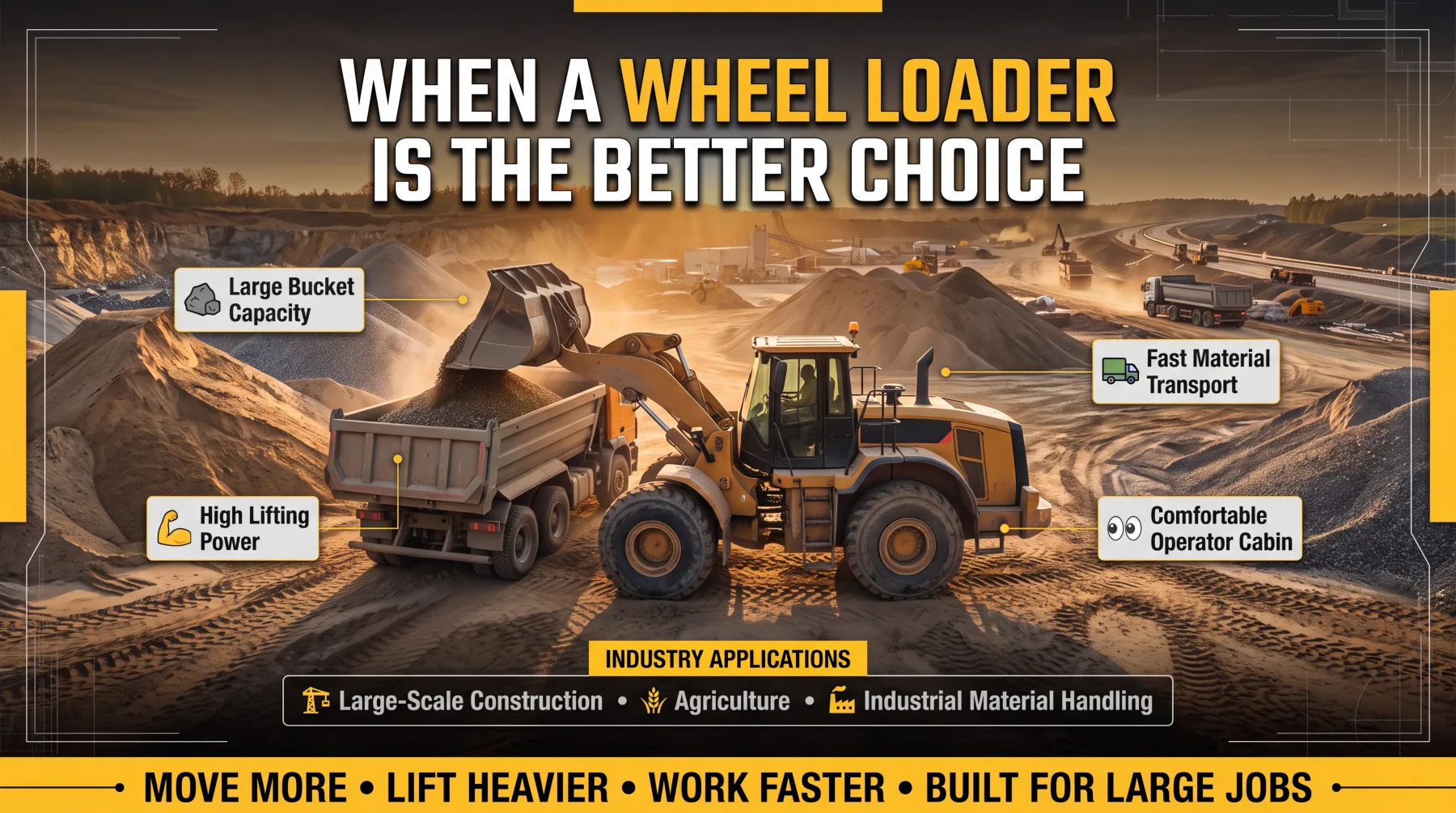
A wheel loader earns its place whenever you need to move large volumes of material over meaningful distances. Its big bucket scoops more with every pass, and its higher travel speed lets it shuttle loads across a site quickly. On jobs where you are hauling soil, aggregate, sand, or grain from one point to another all day long, that combination of capacity and speed translates directly into more work completed in every shift. Fewer trips and faster cycles mean your crew keeps pace with demanding schedules.
Lifting capacity is another area where the wheel loader clearly leads. Its powerful hydraulics and heavy frame let it lift and carry loads that would overwhelm a smaller machine, making it the natural choice for heavy material handling. Operator comfort adds to the appeal on long shifts. Wheel loaders typically offer roomier cabs, better visibility, and a smoother ride, which helps operators stay productive and alert through a full day of demanding work.
These strengths make the wheel loader a dependable performer across several industries:
- Large-scale construction: Moving earth, aggregate, and material efficiently across open sites.
- Agriculture: Handling grain, feed, manure, and bulk materials around farms and storage facilities.
- Industrial applications: Loading trucks, managing stockpiles, and moving heavy materials in quarries and plants.
When your work centers on high volumes, longer travel distances, and heavier loads, the wheel loader delivers the capacity, speed, and comfort those demands require. It is the machine built to keep large operations moving at a steady, productive pace, and it rewards you with efficiency on exactly the kind of big-scale work that smaller equipment simply cannot match.
When a Skid Steer Is the Better Choice
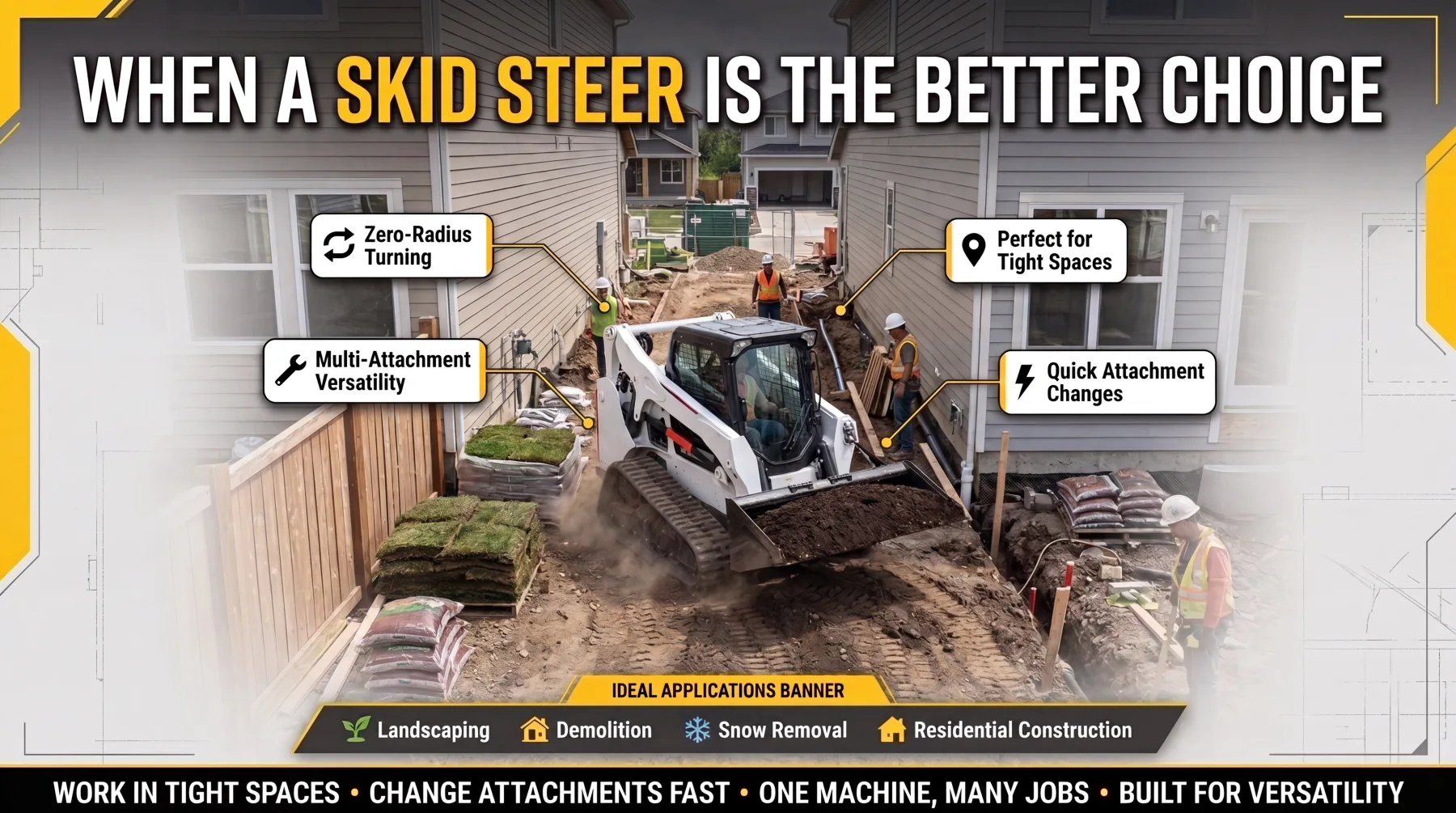
A skid steer shines wherever space is tight and versatility matters most. Its compact frame and zero-radius turning let it work in confined areas that a wheel loader could never enter, from narrow lots to indoor spaces and crowded residential sites. When your job requires precise movement around obstacles, buildings, or landscaping, the skid steer’s maneuverability becomes a genuine advantage, letting operators position the machine exactly where the work demands.
Attachment versatility is the skid steer’s defining strength. A single machine transforms into many tools simply by swapping the attachment on the front, which makes it one of the most adaptable pieces of equipment on any site. Buckets, augers, trenchers, grapples, forks, brooms, and breakers all mount to the same base, so one skid steer can tackle a remarkable range of tasks throughout a project. That flexibility often lets a contractor replace several dedicated machines with one nimble unit.
This blend of compact size and adaptability makes the skid steer ideal for a variety of jobs:
- Landscaping: Grading, digging, moving material, and clearing debris in tight yards and lots.
- Demolition: Breaking, hauling, and cleaning up debris in confined interior and exterior spaces.
- Snow removal: Plowing, blowing, and clearing snow from lots, drives, and walkways.
- Residential construction: Site prep, trenching, backfilling, and material handling around homes.
When your work involves confined spaces, varied tasks, and the need to switch tools quickly, the skid steer delivers the agility and flexibility that keep smaller, more detailed jobs moving. It is the versatile workhorse built for adaptability rather than raw volume, and it proves its worth on exactly the kind of tight, varied work where a larger machine would only get in the way.
Comparing Performance, Cost, and Productivity
Looking past size and steering, a sound decision depends on comparing how the two machines perform on the metrics that shape your bottom line. Lifting capacity is the clearest divide. A wheel loader lifts and carries far heavier loads, giving it the edge on high-volume, heavy-duty work, while a skid steer handles lighter loads with greater precision. Operating efficiency depends on the job itself, since a loader is more efficient over long hauls and large volumes, whereas a skid steer is more efficient in tight, task-varied work where its agility saves time.
Fuel consumption and maintenance follow from each machine’s size and design. A wheel loader’s larger engine burns more fuel, though it moves more material per gallon on the right job. A skid steer sips less fuel overall but works best within its smaller capacity. Maintenance costs track a similar pattern, with the larger loader carrying higher servicing expenses and the compact skid steer generally costing less to maintain. Attachment compatibility tilts toward the skid steer, whose vast ecosystem of tools makes it the more adaptable investment.
Weigh these factors side by side before deciding:
- Lifting capacity: Wheel loaders lead on heavy loads; skid steers handle lighter, precise work.
- Operating efficiency: Loaders excel over distance and volume; skid steers excel in confined, varied tasks.
- Fuel consumption: Loaders use more fuel but move more per pass; skid steers run leaner overall.
- Maintenance: Larger loaders cost more to service; compact skid steers cost less.
- Attachment compatibility: Skid steers offer a wider range of quick-change tools.
Comparing these points honestly, rather than fixating on one number, reveals which machine delivers the best value for the work you actually do. That clarity is what protects your budget and guides a confident investment.
Which Machine Is Right for Your Job?
With the differences and costs in view, the decision comes down to matching each machine’s strengths to your typical projects, job site conditions, and workload. There is no universal winner here, only the machine that fits how you actually work. The most reliable way to decide is to look honestly at the jobs you take on most often and let those realities point you toward the right choice rather than a general rule.
Start with the nature and scale of your work. If your days involve moving large volumes of material across open sites, hauling over distance, or lifting heavy loads, the wheel loader is built for that demand. If instead you work in tight spaces, switch between many tasks, and value the ability to swap tools quickly, the skid steer is the better match. Job site conditions matter just as much, since access width, ground firmness, and how much room you have to maneuver can rule one machine out entirely.
Work through these questions before you commit:
- What do you move, and how much? High volumes and heavy loads favor the wheel loader; lighter, varied work favors the skid steer.
- How much space do you have? Open sites suit the loader; confined areas suit the skid steer.
- How varied are your tasks? Repetitive hauling favors the loader; task variety favors the skid steer’s attachments.
- What is your budget? Consider fuel, maintenance, and long-term return for your specific workload.
Match the machine to your genuine daily reality, and you maximize both productivity and long-term return on your investment.
Conclusion
Choosing between a wheel loader and a skid steer ultimately comes down to aligning the machine with the way you actually work. The wheel loader delivers high volume, heavy lifting capacity, faster travel, and operator comfort, making it the clear choice for large-scale construction, agriculture, and industrial work. The skid steer offers compact maneuverability, quick-change attachment versatility, and lower running costs, making it ideal for landscaping, demolition, snow removal, and residential jobs in tight spaces. The right pick depends on the volume you move, the space you work in, the variety of your tasks, and the total cost each machine carries over time. Take an honest look at your most common projects and job site conditions, weigh them against each machine’s strengths, and let that reality guide your decision. Do that, and you will invest in equipment that keeps your operation productive, efficient, and profitable for years to come.