
Stone Crushing Mechanisms and Aggregate Size Reduction
Rock crushing converts large stones into usable aggregate for road bases, drainage systems, building foundations, and other construction applications. Producing the required material on site can reduce hauling costs and improve supply control, but a single crusher may not deliver every size and shape demanded by different specifications. Selecting a suitable crushing process depends on the feed rock, target gradation, required particle shape, and acceptable fine content.
Crushers reduce material through different mechanisms, including compression, impact, and abrasion. Jaw crushers typically handle primary reduction by compressing large rocks between opposing surfaces, while compact crushers use repeated blows to fracture material and can produce more cubical particles. Feed opening, discharge setting, rock hardness, moisture, and wear-part condition all influence throughput, particle size, and the consistency of the finished aggregate.
Efficient crushing requires matching each stage to the material and intended application. Screening can separate correctly sized aggregate and return oversized pieces for further processing, while regular inspection of jaw dies, blow bars, and other wear components helps maintain product quality. Operators must also control feed size, follow manufacturer settings, and isolate the machine before clearing blockages to support safe, reliable production.
Feed Size and Material Hardness
The size and hardness of incoming rock have as much influence on crushing performance as the crusher itself. Every crusher has a specified maximum feed size, set by the dimensions of its feed opening and chamber. Material that exceeds that limit can bridge across the opening, wedge between the crushing surfaces, or place excessive force on the drive, bearings, and frame. Many manufacturers recommend a maximum feed size well below the full width of the opening, often around 80 percent, so rock can enter cleanly and be gripped by the crushing surfaces. Follow the specification for your machine rather than judging by eye.
Shape matters along with size. Flat, slabby pieces can turn sideways and bridge across the opening even when one of their dimensions is within the limit. Long, narrow pieces can slip through a jaw without breaking properly. Blocky feed generally enters and breaks more predictably. Preparing feed before it reaches the hopper, by breaking oversized rock with a hydraulic breaker and setting aside awkward slabs, keeps material flowing and reduces stoppages.
Hardness describes how much force a rock requires to break. Dense natural stone such as granite and basalt demands far more crushing energy than limestone, sandstone, or brick. Harder rock generally slows throughput and places greater loads on the crusher. Abrasiveness is a related but separate property. Rock with high silica or quartz content grinds away at jaw dies, blow bars, and liners with every pass, and very abrasive material can shorten wear part life dramatically. A rock can be moderately hard but highly abrasive, so consider both properties when choosing a crusher and planning wear part budgets.
Moisture and contamination also affect how material moves through the crusher. Wet clay and sticky fines can pack the chamber and reduce capacity, especially at tight settings. Steel, wood, and other non-crushable material can damage crushing surfaces and drive components. Removing fines through a grizzly section or prescreen, sorting out tramp material, and using magnetic separation where equipped all help protect the machine and keep output clean.
Feed material should always remain within the manufacturer’s permitted limits. If material bridges or blocks the chamber, stop the feeder and crusher and follow the manufacturer’s procedure for clearing the blockage, which typically requires a full shutdown and lockout. Never use hands, feet, or a bar to clear material while the crusher is running, never climb onto the hopper or feeder during operation, and never stand where ejected rock could strike you.
Key takeaway: Oversized feed can cause blockages and exceed the crusher’s specifications, while hard or abrasive rock increases crushing demand and wear, so keep feed within the manufacturer’s limits and prepare material before it reaches the hopper.
Jaw Crushing and Initial Size Reduction
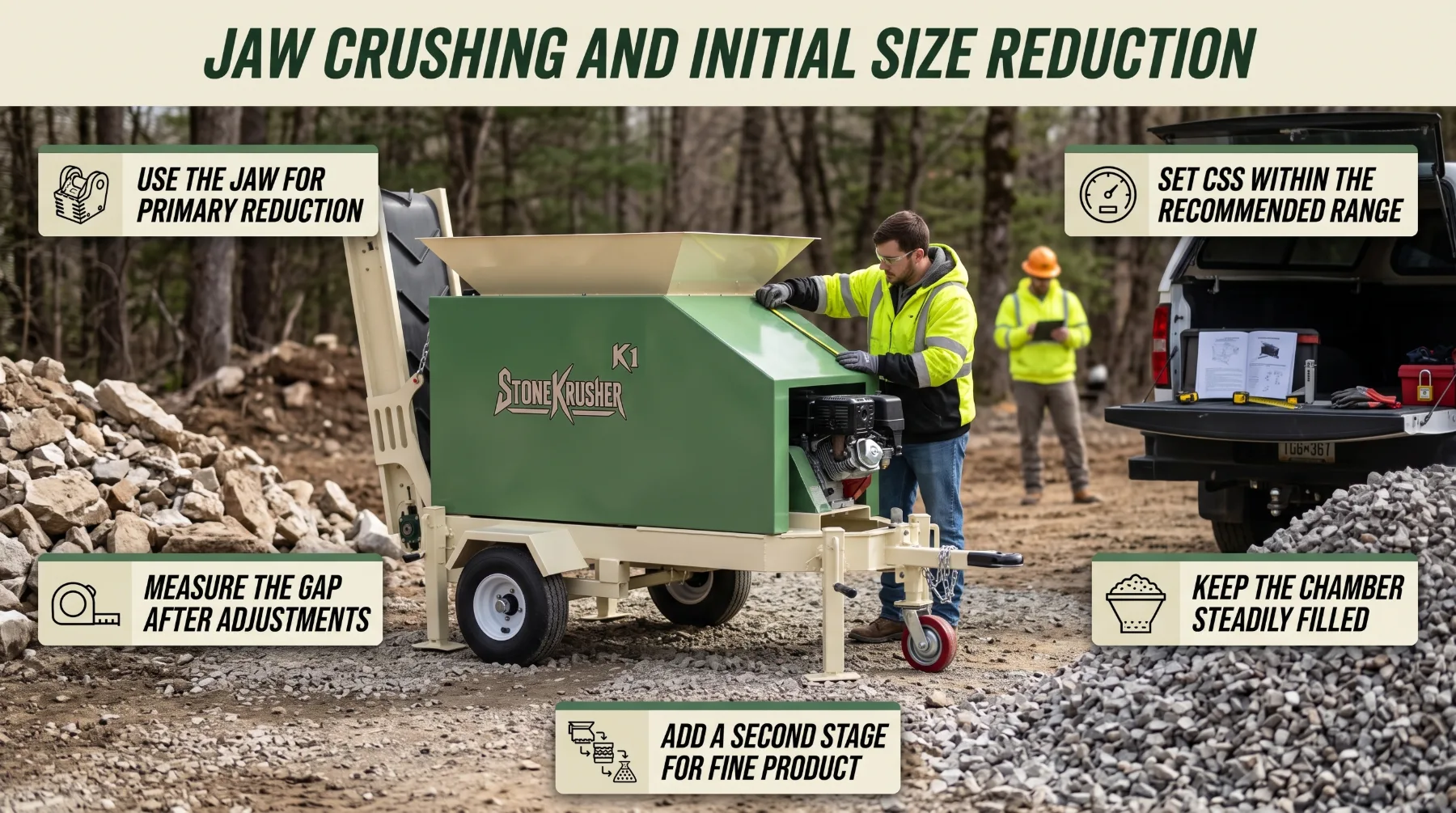
Jaw crushers are the workhorses of initial size reduction. They use two crushing surfaces, typically one fixed and one moving, set in a V-shaped chamber. The moving jaw is driven by an eccentric shaft and flywheel, and it swings toward and away from the fixed jaw in a repeating stroke. As it closes, it compresses rock against the fixed jaw. As it opens, broken pieces drop lower into the narrower section of the chamber, where the next stroke crushes them again.
Jaw crushers are commonly used for primary reduction, where large feed material must be broken into smaller pieces for further processing or direct use. Their wide feed opening accepts large rock, boulders, and broken concrete that other crusher types can’t handle. A jaw crusher can produce usable material on its own, such as road base, fill, or riprap, depending on the setting. On many operations, though, it serves as the first stage, reducing material to a size that secondary crushers, such as impact or cone crushers, can refine into a specific product.
The closed side setting is the most important adjustment on a jaw crusher. It’s the smallest gap between the jaws at the bottom of the stroke, and it largely controls the maximum product size. The open side setting is the gap at the widest point of the stroke. Because material can pass while the jaw is opening, a share of the product will be larger than the closed side setting. That’s normal, and it’s one reason a screen often follows the crusher when a project needs a tight size range.
Every jaw crusher has a practical range of settings. Closing the setting far below the manufacturer’s recommended range, as the camp crew did, packs the chamber, reduces capacity, increases stress on the drive and frame, and can trip overload protection. It can also increase flaky particles and fines. Each crushing stage achieves a practical reduction ratio, so when a project calls for small aggregate from large feed, the better approach is usually a second crushing stage rather than forcing the primary crusher beyond its range.
Jaw crushers perform best with consistent feed that keeps the chamber steadily filled. Many manufacturers recommend keeping the chamber well filled rather than allowing it to run nearly empty, which helps rock break against other rock and supports more even wear on the jaw dies. Adjust the setting only according to the manufacturer’s procedure, with the crusher stopped and locked out where required, and measure the actual gap after any adjustment or die change instead of relying on gauge readings alone.
Key takeaway: Jaw crushers compress rock between a fixed and moving jaw and are often used for primary size reduction, with the closed side setting controlling maximum product size within the manufacturer’s recommended range.
Wear Parts and Crushing System Maintenance
Crushing rock is among the most demanding work any machine can perform. Crushing surfaces, liners, bearings, drive components, and other wear parts experience repeated mechanical loads with every stroke or rotation. As they wear, crushing efficiency drops, product quality changes, and the risk of an unexpected breakdown rises. Regular inspection and replacement according to the manufacturer’s instructions keep the crushing system productive and protect the investment it represents.
Every inspection begins with safety. Shut down the crusher, feeder, and conveyors, follow the manufacturer’s lockout procedure, and confirm all moving parts have stopped. Flywheels and rotors can continue turning after shutdown, so wait for a complete stop before opening any access. Never enter the hopper or chamber without following the manufacturer’s procedures and applicable confined space and lockout requirements.
Crushing surfaces deserve the closest attention. Inspect jaw dies, blow bars, mantles, and concave liners for wear, cracks, and uneven profiles. Worn surfaces often show up first in the product as oversized pieces, flaky particles, or a shift in gradation. Many jaw dies can be flipped or rotated to bring fresh profile to the high-wear area near the discharge, and many blow bars can be reversed to use their second wearing edge. Replace wear parts before they wear through to their backing or mounting surfaces, which are far more costly to repair. Check cheek plates, side liners, and impact aprons as well, since worn liners expose the crusher frame to direct abrasion.
Settings need regular measurement because wear opens them over time. Measure the closed side setting on jaw and cone crushers and the apron gaps on impact crushers at regular intervals and after every wear part changes. Adjust them according to the manufacturer’s procedure so product size stays within specification.
Bearings and drive components carry heavy, constant loads. Inspect bearings for heat, noise, and grease leaking past damaged seals, and lubricate them according to the manufacturer’s schedule with the specified grease or oil. Check drive belts for cracks, glazing, and correct tension. Inspect the flywheel, eccentric shaft, toggle plate, tension rods, and rotor assembly where equipped. Examine hydraulic hoses and cylinders used for setting adjustment and overload relief, and never search for a leak with your hands, since pressurized fluid can penetrate skin and cause serious injury. Use a piece of cardboard instead.
Feed systems need attention, too. Hopper liners, feeder pans, grizzly bars, and feeder mounts wear steadily, and worn grizzly bars can let oversized material bypass the chamber or block fines from dropping through. Confirm every guard is present and secure before restarting the machine.
Record every inspection, setting measurement, part replacement, and repair in a maintenance log, along with the date and hour meter reading. Wear rates vary widely with material hardness and abrasiveness, so good records help you predict replacement timing, keep the right spare parts in stock, and schedule changes between jobs rather than in the middle of production. Running a crusher with badly worn parts almost always costs more in lost output and off-specification product than replacing them on schedule.
Key takeaway: Inspect crushing surfaces, liners, bearings, drive components, and feed systems regularly with the crusher locked out, measure settings as parts wear, and replace components according to the manufacturer’s instructions to maintain efficiency and reduce breakdowns.
Factors Affecting Finished Aggregate Size
The finished product is the reason any crushing operation exists, and several factors work together to decide its size, shape, and gradation. Gradation, sometimes called particle size distribution, describes the mix of particle sizes in the product, from the largest stones down to the fines. Road base, drainage stone, pipe bedding, and concrete aggregate each require a different gradation, so understanding what controls output helps you produce material that meets specification the first time.
The crusher type sets the foundation. Compression crushers and impact crushers break rock differently, and that difference shows up in particle shape and fine content. Chamber geometry adds another layer of control. The shape of the jaw dies, mantle and concave, or impact aprons determines how material moves through the chamber, how many times it’s crushed, and how evenly it breaks. A chamber designed for coarse primary crushing behaves very differently from one built for fine secondary work.
Feed characteristics shape the result as well. Harder rock, larger feed, and inconsistent feed size all affect how material fractures. Soft rock may break down into more fines, while very hard rock may hold its shape and produce coarser output at the same setting. Moisture can cause fines to cling to larger stones, which changes test results and can interfere with screening.
Machine settings give the operator direct control. The closed side setting on a jaw or cone crusher largely governs maximum product size, while apron gaps and rotor speed shape output on an impact crusher. Feed rate matters too, since a steadily filled chamber typically produces a more consistent product than one that alternates between overfeeding and running nearly empty.
The condition of wear components is easy to overlook, yet it changes output every hour the crusher runs. As jaw dies, blow bars, and liners wear, discharge gaps open and crushing profiles change. Product size drifts upward, and particle shape may deteriorate. That’s why regular setting checks belong in every crushing routine.
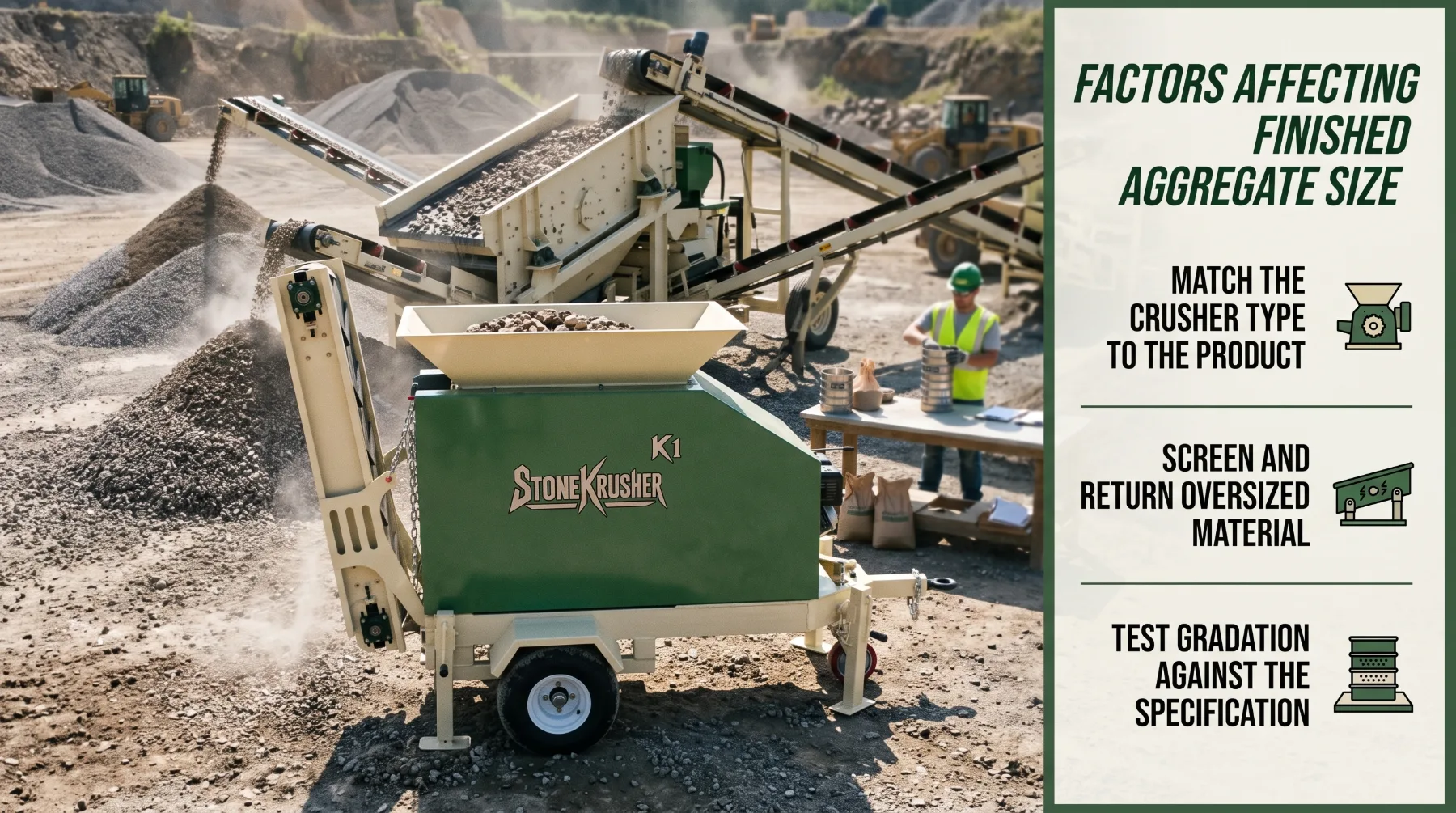
Many operations add screening or additional crushing stages to achieve a narrower size range. A screen after the crusher separates finished product from oversized material, which can be returned to the crusher for another pass in what’s called a closed circuit. Multiple stages let each crusher work within its practical reduction range and often improve both shape and efficiency compared with forcing one crusher to do everything.
Actual output should always be verified against project requirements. Take samples from the discharge conveyor or stockpile, following safe sampling locations and procedures, and have them tested for gradation and, where specified, particle shape. Sample regularly, since output drifts as wear parts wear and feed changes. Build stockpiles in layers or with consistent conveyor placement where practical, since tall, cone-shaped piles can allow larger stones to roll to the bottom and separate from smaller material.
Key takeaway: Finished aggregate size depends on crusher type, chamber geometry, feed characteristics, machine settings, and wear component condition, so use screening or additional stages where needed and verify output against project requirements.
Conclusion
Stone crushing mechanisms reduce rock through compression, impact, and other machine-specific actions, and the strongest results come from matching each mechanism to the work it does best. Compression crushers squeeze rock between solid surfaces and handle hard, abrasive material with fewer fines. Impact crushers break rock with high-speed blows and often produce well-shaped, cubical aggregate from softer, less abrasive feed. Jaw crushers provide dependable primary reduction when they run within their recommended settings, and feed kept within the manufacturer’s size limits, with attention to hardness and abrasiveness, keeps material flowing without blockages or excessive wear. Crusher type, chamber geometry, feed characteristics, settings, and wear part condition together decide the finished aggregate size, while screening and additional stages help achieve a narrower range. Routine inspection and timely replacement of wear parts, bearings, and drive components keep the system producing consistent material. When you match the crushing system to the intended application, you deliver an aggregate that meets specification, protects your equipment, and keeps projects on schedule for the customers who count on you.
Before your next crushing job, work through a simple pre-job checklist. Identify the rock you’ll process and note its hardness, abrasiveness, moisture, and any contaminants. Confirm the products and gradations the project requires, and decide whether one crushing stage can produce them or whether a secondary crusher and screen are needed. Compare your largest typical feed pieces against each crusher’s recommended maximum feed size, and plan pre-breaking for oversized material. Check that the closed side setting, apron gaps, or rotor speed fall within the manufacturer’s recommended range for the product you need, and measure them before starting. Inspect jaw dies, blow bars, liners, bearings, belts, and guards with the machine locked out. Plan dust and noise controls and a marked exclusion zone around the feed and discharge areas. Finally, schedule regular product sampling so you can confirm every stockpile meets specification.
Frequently Asked Questions
What are the main stone crushing mechanisms?
The main stone crushing mechanisms are compression and impact. Compression crushers, such as jaw and cone crushers, squeeze rock between solid surfaces until it fractures into smaller pieces. Impact crushers use high-speed blows from a rotor and collisions with internal surfaces to break material apart. These mechanisms produce different particle shapes and amounts of fine material, making each suitable for different applications. The best choice depends on the rock type, required aggregate size, and intended use of the finished material.
What determines the finished aggregate size?
Finished aggregate size depends on crusher design, chamber geometry, feed size, material hardness, operating settings, and wear part condition. Some jobs require a single crushing stage, while others need additional crushing and screening to achieve the target size range. Regularly checking settings and inspecting wear parts helps maintain consistent output as components wear. Sampling the finished aggregate also confirms whether the material meets project specifications and helps identify when adjustments are needed.
Why is maximum feed size important?
Maximum feed size determines the largest material pieces a crusher can accept within its specified operating limits. Oversized rock can cause bridging, blockages, reduced efficiency, or excessive stress on machine components. Breaking large pieces into suitable sizes before loading helps maintain a steady material flow and reduces interruptions. Operators should check feed dimensions against the manufacturer’s specifications and avoid forcing oversized material into the chamber. Any blockage must be cleared using the approved procedure, with the equipment shut down, isolated, and locked out as required.
How can crusher performance be maintained?
Regular maintenance helps keep a stone crusher operating efficiently and reduces unexpected downtime. Inspect wear parts, bearings, drive components, and feed systems for damage, excessive wear, or abnormal movement. Check crusher settings as crushing surfaces wear, and replace components according to the manufacturer’s recommendations. Keeping feed material within specified limits and following correct operating procedures also helps maintain consistent output. A maintenance log records inspections, repairs, and component changes, making it easier to plan servicing and replacement parts before problems interrupt production.