
A forklift warehouse setup can make daily material handling faster, safer, and more organized. But the right forklift depends on the size of the warehouse, the type of loads, aisle space, floor condition, and how often the machine will be used.
For a small storage facility, a compact electric forklift may be enough. For a busy distribution center, you may need stronger lifting capacity, longer battery life, and better turning control. This guide explains the basics in simple terms so buyers, operators, and business owners can make better decisions.
What Is a Forklift Used for in a Warehouse?
A warehouse forklift is mainly used to move, lift, stack, and load materials. It helps workers handle pallets, boxes, crates, equipment, and heavy goods that are too large or heavy to move by hand.
Common warehouse forklift jobs include:
- Moving pallets from receiving areas to storage racks
- Loading and unloading trucks
- Stacking goods on shelves or pallet racks
- Picking and placing inventory
- Moving products between warehouse zones
- Supporting packing, shipping, and order fulfillment work
In most warehouses, forklifts save time because they reduce manual lifting and shorten the distance workers need to carry materials. They also help keep storage areas cleaner when goods are stacked properly instead of left on the floor.
Why the Right Forklift Matters in a Warehouse
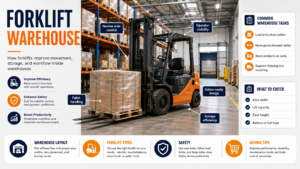
Not every forklift is suitable for every warehouse. A machine that works well outside may be too large, too loud, or poorly suited for narrow indoor aisles. A small forklift may be easy to drive but may not have enough lifting height or capacity for heavy pallets.
The right forklift should match the work environment. Important factors include:
- Aisle width
- Ceiling height
- Rack height
- Pallet weight
- Floor surface
- Turning space
- Battery or fuel needs
- Indoor ventilation
- Daily working hours
For example, an electric forklift is often a good choice for indoor warehouse use because it produces no direct exhaust while operating. It is usually quieter than fuel-powered machines and easier to use in closed spaces. But if the machine runs for long shifts, battery capacity and charging time become important.
Choosing the wrong forklift can slow down work, damage racks or products, increase safety risks, and cost more over time.
Common Types of Warehouse Forklifts
Several types of forklifts are used in warehouses. The best choice depends on how the warehouse is laid out and what the machine needs to lift.
Counterbalance Forklift
A counterbalance forklift is one of the most common forklift types. It has forks at the front and a weight at the back to balance the load. It works well for loading trucks, moving pallets, and general warehouse use.
This type is simple to understand and useful for many businesses, but it needs enough room to turn. In tight aisles, it may not be the best option.
Electric Forklift
Electric forklifts are popular for indoor warehouse work. They are quiet, clean, and often easier to maintain than diesel or gas models. They are commonly used in storage facilities, retail warehouses, food storage areas, and distribution centers.
Buyers should check battery life, charging time, lifting capacity, and whether the warehouse has a proper charging area.
Reach Truck
A reach truck is designed for high racks and narrow aisles. It can extend its forks forward to place pallets into deep or tall storage positions. This makes it useful for warehouses that need more vertical storage space.
Reach trucks are not usually the best choice for rough outdoor surfaces. They are mainly built for smooth indoor floors.
Pallet Jack and Walkie Stacker
For smaller warehouses, a powered pallet jack or walkie stacker may be enough. These machines are useful for moving pallets short distances and handling lighter lifting tasks.
They are not as powerful as a full forklift, but they can be more affordable and easier to use in tight areas.
Key Features to Check Before Choosing a Forklift
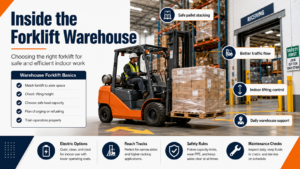
Before buying or renting a forklift for warehouse work, check the actual job requirements. Do not choose only by price or machine size.
Start with lifting capacity. The forklift must safely handle the heaviest pallet or load you plan to move. Always check the rated capacity, and remember that capacity can change depending on lift height and load position.
Next, check lift height. If the warehouse uses tall pallet racks, the forklift must reach the required shelf level while staying stable.
Aisle width is also important. Measure the tightest working areas, not just the main warehouse paths. The forklift needs enough space to turn, line up with racks, and move without hitting posts, shelves, or products.
Other features to check include:
- Fork length
- Mast type
- Turning radius
- Tire type
- Battery capacity or fuel type
- Operator visibility
- Seat comfort
- Control layout
- Attachment compatibility
- Service access
For indoor warehouse use, smooth tires and compact turning are often more important than rough-terrain strength.
Forklift Warehouse Safety Basics
Forklift warehouse safety starts with training and clear traffic rules. A forklift may look simple, but it can cause serious damage if it is used carelessly in tight spaces.
Operators should know how to inspect the machine, handle loads, watch blind spots, and drive at a safe speed. Workers on foot should also understand forklift lanes and stay away from moving equipment.
Basic safety habits include:
- Inspect the forklift before each shift
- Keep loads low while driving
- Do not overload the machine
- Slow down near corners and doors
- Use horns at blind spots
- Keep people away from raised forks
- Avoid sudden turns with heavy loads
- Keep aisles clear
- Watch rack height and overhead clearance
- Park with forks lowered
A warehouse should also have clear signs, marked lanes, mirrors in blind corners, and enough lighting. Safety is not only about the operator. The layout of the warehouse matters too.
Buying or Renting a Forklift for Warehouse Work
Buying makes sense if the forklift will be used often and the business needs long-term control over the machine. It may cost more upfront, but it can be more practical for daily warehouse operations.
Renting may be better for short projects, seasonal demand, temporary storage work, or when a business wants to test a forklift before buying. It also helps avoid large upfront costs.
Before deciding, ask these questions:
- How many hours will the forklift run each week?
- Is the work temporary or long-term?
- Do you have trained operators?
- Do you have space for charging or refueling?
- Who will handle maintenance?
- Will the warehouse layout change soon?
- What is the cost of downtime if the machine fails?
For many businesses, the best choice is not the biggest forklift. It is the machine that fits the warehouse layout, handles the load safely, and stays reliable during normal work.
Simple Maintenance Tips for Warehouse Forklifts
A warehouse forklift should be checked regularly, even if it is used only indoors. Small problems can lead to safety risks or expensive repairs if ignored.
For electric forklifts, battery care is one of the most important maintenance tasks. Operators should follow proper charging habits, check battery water levels if required, and avoid using a weak battery until it is fully drained.
For all warehouse forklifts, basic maintenance should include:
- Checking tires for wear
- Looking for fluid leaks
- Testing brakes and steering
- Inspecting forks for cracks or bending
- Checking lights, horn, and warning alarms
- Cleaning dust from key areas
- Checking the mast and chains
- Reporting unusual noises early
A simple inspection routine can prevent downtime and help the forklift last longer. It also keeps operators more confident during daily work.
Conclusion
A forklift warehouse setup should be chosen based on real work needs, not just machine size or price. The right forklift should fit the aisle space, lift the required loads, reach the right height, and support safe daily operation.
For most indoor warehouses, electric forklifts, reach trucks, pallet jacks, and compact counterbalance forklifts are common choices. Before buying or renting, measure the warehouse, understand the load requirements, and think about long-term maintenance. A well-matched forklift can make warehouse work faster, cleaner, and safer without adding unnecessary cost.