
A USA excavator can mean different things depending on what the buyer needs. Some people are looking for an excavator available in the United States. Others want a machine that can handle American jobsite conditions, has parts support, and fits local construction, landscaping, farming, or property work.
The right excavator is not always the biggest one or the most expensive one. It is the machine that fits your job, your transport setup, your budget, and the type of work you do most often.
What Buyers Usually Mean by “USA Excavator”
When someone searches for a USA excavator, they are usually looking for a machine that is easy to buy, ship, service, and use in the United States.
That may include:
- Excavators already available for U.S. buyers
- Machines with suitable engines and specs for local use
- Equipment that can be shipped to a jobsite or property
- Parts and service support after purchase
- Machines that work for construction, landscaping, farms, and private land
For a beginner buyer, this matters because the purchase does not stop when the machine arrives. You also need to think about maintenance, attachments, replacement parts, and whether the machine fits your daily work.
Common Jobs for Excavators in the United States
Excavators are used across many types of work. A small business owner may use one for site prep. A landscaper may use one for grading or trenching. A property owner may use one for drainage, driveway repair, or land clearing.
Common excavator jobs include:
- Digging trenches for pipes, drains, and utilities
- Removing stumps, rocks, and small trees
- Grading soil around homes, roads, or job areas
- Loading dirt, gravel, and debris
- Preparing land for buildings, fencing, or landscaping
- Cleaning ditches and drainage areas
- Demolition work on small structures or concrete
The type of work you do should guide the size and features you choose. A machine used for backyard trenching does not need the same power as one used for heavy commercial digging.
Choosing the Right Excavator Size
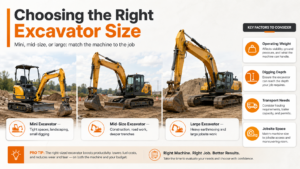
Excavator size is one of the most important buying decisions. Bigger machines offer more digging force and reach, but they also cost more, need more space, and are harder to transport.
Mini excavators are popular for small contractors, landscapers, homeowners with land, and farm use. They are easier to move, easier to operate in tight spaces, and usually cost less to own. They are a good fit for trenching, small foundations, drainage work, light demolition, and property maintenance.
Mid-size excavators are better for heavier digging, larger construction sites, road work, and bigger earthmoving jobs. They have more reach, more lifting power, and stronger hydraulic performance, but they need a proper trailer, truck, and operator experience.
Large excavators are built for serious construction, mining, quarry work, and large-scale site development. Most beginner buyers do not need this size unless they are running large commercial jobs.
For most first-time buyers, the smart choice is to start with the smallest machine that can safely handle the work. That keeps cost, transport, and maintenance easier to manage.
Features That Matter Before You Buy
A USA excavator should be judged by more than price. The machine needs to be practical on the job.
Look closely at these features before buying:
Operating weight
This tells you how heavy the machine is. It affects stability, digging power, and transport needs.
Digging depth
Make sure the excavator can dig deep enough for your common jobs, such as drainage lines, footings, or utility trenches.
Engine power
More horsepower can help with tougher digging, but it also affects fuel use and maintenance.
Hydraulic flow
This matters if you plan to use attachments like breakers, augers, thumbs, or grapples.
Track type
Rubber tracks are better for lawns, pavement, and finished surfaces. Steel tracks are stronger for rough ground but can damage softer areas.
Cab or canopy
A canopy is simple and common on smaller machines. A cab gives more comfort and weather protection, especially for long workdays.
Boom swing
Boom swing helps when digging close to walls, fences, buildings, and tight corners.
These details are not just technical specs. They decide how useful the machine will be once it is on your site.
New, Used, or Imported Excavator: Which One Makes Sense?
Many buyers compare new, used, and imported excavators before making a decision. Each option has pros and trade-offs.
A new excavator usually gives you cleaner condition, updated features, and fewer unknown problems. It may cost more upfront, but it can save time if you want a machine that is ready to work.
A used excavator can be a good value, but it needs careful inspection. Check engine hours, hydraulic leaks, track wear, pins, bushings, bucket condition, and service history. A cheap used machine can become expensive if major repairs are needed soon after purchase.
An imported excavator may offer a lower price, especially in the compact equipment market. The key is to check parts availability, engine details, hydraulic compatibility, delivery process, and after-sale support.
For business owners, downtime costs money. A slightly higher purchase price can be worth it if the machine is easier to service and keep working.
Attachments That Make an Excavator More Useful
The bucket is only one part of what an excavator can do. Attachments can turn one machine into a more flexible tool for different jobs.
Useful excavator attachments include:
- Trenching bucket for narrow digging
- Grading bucket for smoothing and shaping soil
- Hydraulic thumb for grabbing logs, rocks, and debris
- Auger for drilling fence posts, trees, and foundation holes
- Hydraulic breaker for concrete and rock removal
- Rake for cleanup, brush work, and land clearing
- Grapple for handling loose material
Before buying attachments, check the machine’s hydraulic flow, coupler type, weight limits, and pin size. Not every attachment fits every excavator.
If you plan to use several attachments, ask about compatibility before you buy the machine. It is easier to match everything early than to fix fitment problems later.
Buying Tips for First-Time Excavator Buyers
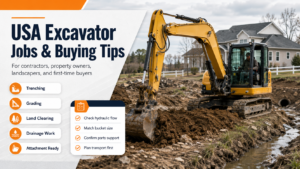
A first-time buyer should avoid rushing the purchase. The best excavator is the one that fits real work, not just the one with the best-looking listing.
Start by listing the jobs you need the machine to do. Then check the size, digging depth, lift capacity, and attachment needs. Think about how you will move the machine, where you will store it, and who will maintain it.
A few practical tips:
- Do not buy more machine than you can transport
- Check the machine width if you work in tight spaces
- Match the bucket size to the soil and job type
- Ask about parts support before buying
- Check whether attachments are included or sold separately
- Compare total cost, not only the listed price
- Make sure the machine is stable enough for your work
For small businesses and property owners, a compact excavator often gives the best balance of cost, control, and usefulness. For heavier work, stepping up in size may be worth it.
Conclusion
A USA excavator should fit your job, budget, support needs, and long-term use. Do not choose only by price or size. Look at the work you do most, the attachments you need, and how easy the machine will be to transport and maintain.
For many buyers, the right machine is a compact or mini excavator that can handle daily digging, grading, cleanup, and property work without becoming difficult to own.