
Wheel loader lifting is one of the main reasons people buy a wheel loader. These machines are used to scoop, lift, carry, dump, and move materials across farms, construction sites, yards, warehouses, and property maintenance areas.
For beginners, the important thing to understand is that lifting is not only about how high the loader arms can go. You also need to know how much weight the machine can handle, what attachment is being used, what material is being lifted, and how stable the ground is.
What Does Wheel Loader Lifting Mean?
Wheel loader lifting means using the loader arms, bucket, forks, or another attachment to raise and move material. In real work, this can mean loading soil into a truck, moving gravel across a yard, stacking pallets, carrying mulch, lifting feed, or handling construction materials.
A wheel loader does not lift the same way in every situation. A bucket full of mulch is very different from a bucket full of wet gravel. A pallet carried on forks is also different from loose material carried in a bucket.
This is why buyers should not look at only one number. A good lifting decision depends on the machine, the attachment, the material, and the jobsite.
Lifting Capacity Is Not One Simple Number
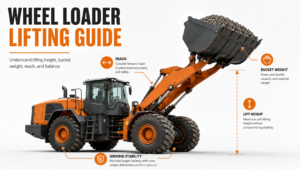
Many buyers ask, “How much can a wheel loader lift?” The better answer is, “It depends on the setup.”
Wheel loaders can have different ratings for bucket work, fork work, and other lifting applications. A loader may handle one type of load safely but need a smaller load when the material is heavier, the ground is uneven, or the attachment changes the balance.
For bucket work, buyers should pay attention to the rated load and the machine’s tipping limit. A loader’s full-turn static tipping load is an important rating because it shows the weight limit when the loader is articulated and the arms are in a tested position. The rated load is normally lower than the tipping limit because it is meant to give a safer working capacity.
This is also why the operator manual matters. The manual gives the correct capacity information for that specific machine, not a rough guess based on size.
Bucket Lifting vs Fork Lifting
Most people think of wheel loaders with buckets, but many wheel loaders can also use pallet forks and other attachments.
Bucket lifting is common for loose material such as soil, sand, gravel, snow, compost, feed, and mulch. In this case, the weight depends on both the bucket size and the material density. A large bucket may be fine for light material, but too heavy when filled with dense material.
Fork lifting is different. When a wheel loader uses forks, the load is usually farther forward than a bucket load. That extra distance can reduce stability. This is why load position matters so much when lifting pallets, blocks, logs, or large single objects.
Attachment weight also matters. If a lifting rating does not include the attachment, the attachment weight should be counted against the usable lifting capacity. For example, a heavier bucket, quick coupler, fork frame, or grapple can reduce how much useful load the machine can safely carry.
What Affects Wheel Loader Lifting Capacity?
Wheel loader lifting capacity is affected by machine size, machine weight, hydraulic strength, arm design, attachment type, tire setup, and counterweight.
A heavier wheel loader usually has better stability than a very light machine, but weight alone is not enough. The loader also needs the right hydraulic power and the right frame design for the job.
Lift height also changes how the machine feels during work. A loader may feel stable while carrying a load low, but less stable when the same load is raised high. This is why operators should carry loads low while traveling and only raise the load when needed.
Ground condition is another major factor. Smooth, level concrete is very different from soft soil, loose gravel, mud, slopes, or uneven construction ground. Uneven ground can reduce safe lifting performance because the machine can shift, bounce, or lean while carrying weight.
Why Material Weight Matters
Wheel loader lifting is closely connected to material weight. The same bucket can carry very different amounts depending on what is inside it.
Light material such as mulch, dry snow, or wood chips may allow a larger bucket because the material does not add too much weight. Heavy material such as wet soil, gravel, rock, or concrete needs more care because the bucket can become heavy very quickly.
This is one reason bucket size should match the material. A bucket that looks productive on paper can overload the machine if it is used with dense material. Choosing the correct bucket helps reduce tipping risk, machine strain, fuel waste, and unnecessary wear.
For normal buyers, the simple rule is this: do not choose a bucket only by volume. Think about what material you will carry every day.
Safe Wheel Loader Lifting Tips
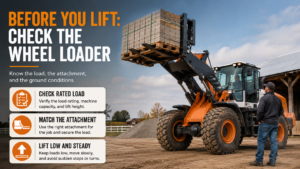
Safe wheel loader lifting starts with knowing the machine’s real limits. The operator should check the manual, understand the rated load, and avoid lifting more than the machine is designed to handle.
The load should be kept low when driving. A raised load can make the machine easier to tip, especially during turning, braking, or traveling on uneven ground.
Operators should avoid sudden movements when lifting heavy material. Fast steering, sharp braking, and quick arm movement can shift weight and reduce control.
It is also important to avoid guessing. If the material is heavier than expected, use a smaller bucket load or make more passes. A slower, safer cycle is better than overloading the machine and risking damage or injury.
What Buyers Should Check Before Choosing a Wheel Loader
Before choosing a wheel loader, buyers should think about the actual work, not only the biggest number in the spec sheet.
Start with the material. Will the loader handle mulch, soil, gravel, pallets, feed, snow, or construction waste? Then think about the jobsite. Will it work on concrete, dirt, slopes, farms, tight yards, or loading areas?
Next, check lifting height and reach. If the loader needs to load trucks, hoppers, bins, or trailers, dump height matters. If the loader needs extra forward reach, a telescopic wheel loader may be useful, but the buyer still needs to understand how capacity changes when the arm is extended.
For compact machines, lifting capacity should be explained carefully. A machine may have one rated load, another maximum load with the main arm, and a different limit when using an extended arm. The farther the load moves away from the machine, the more carefully the buyer should read the specs.
Conclusion
Wheel loader lifting is about more than lifting a heavy load. It is about matching the machine, attachment, material, ground condition, and lifting height to the job.
For beginners, the best approach is simple. Check the rated load, understand the attachment, know the material weight, and avoid pushing the machine beyond its safe working limit. A wheel loader that fits the job properly will be safer, easier to operate, and more useful every day.